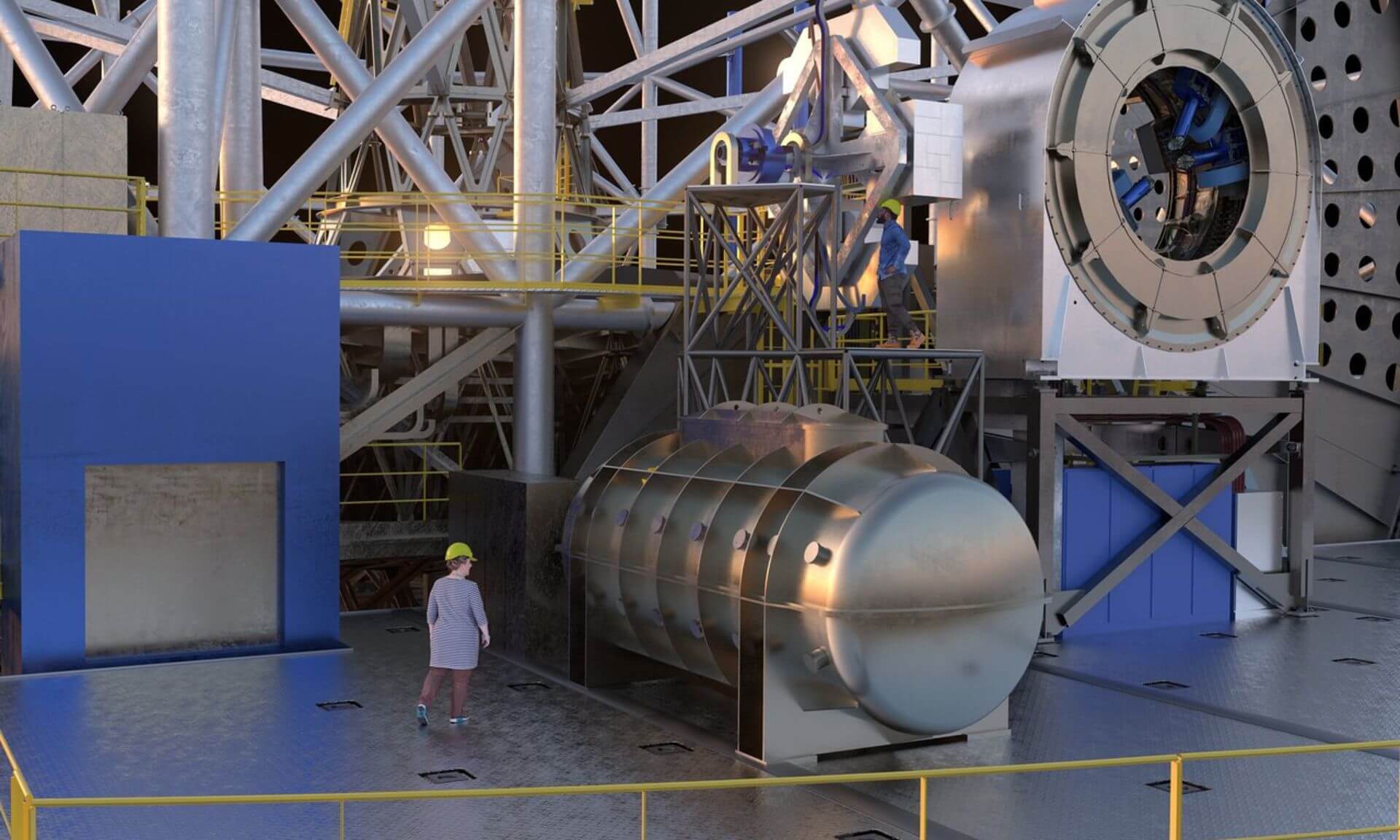
The European Extremely Large Telescope (ELT) now under construction in Chile will soon be the most powerful optical and infrared telescope ever built — and Canada will have a major role in its development.
To that end, Canadian scientists led by teams at Université de Montréal, the Mont-Mégantic Observatory (OMM), and the Trottier Institute for Research on Exoplanets (IREx) in partnership with the University of British Columbia have been awarded grants totalling $22.6 million.
Of that, $11.3 million comes from the Canada Foundation for Innovation (CFI), $5.7 million from the Quebec Ministry of Higher Education, $3.8 million from the Government of Ontario and $1.8 million (pending approval) from the Government of British Columbia.
The investments are to support Canada’s contribution to the ANDES instrument on the ELT. The CFI's grant is the sixth-largest awarded under its 2026 competition, and is doubled by Quebec, Ontario and B.C..
At 39 metres in diameter, the ELT will be the first of a new class of “giant telescopes,” capable of observing the universe in unprecedented detail. With first light expected later this decade, it will open a new window onto everything from nearby exoplanets to the most distant galaxies.
Opportunities not to be missed in Canada
Canada is not currently a member of the European Southern Observatory (ESO), the organization building and operating the ELT. However, through the CFI's investment in ANDES, Canadian astronomers will gain guaranteed access to the telescope, something that would otherwise not be possible.
“This is a transformative moment for Canadian astronomy, propelling Canada into a leading role in what may become the most powerful ground-based telescope ever built,” said UdeM physics professor René Doyon, director of the OMM and IREx and co-principal investigator of the Canadian contribution to ANDES.
For decades, access to a very large optical telescope has been considered a top priority for Canada, including in the Canadian Astronomical Society’s Long Range Plan for the 2020s.
"With delays presently affecting other international projects, the ELT represents the best way in the near-term for Canada to participate in this new era of observational astronomy," said Doyon. "Without this contribution, we risk being excluded from some of the most important astronomical discoveries of the next decade."